
The countries with the most trust need fewer laws
When trust rises, bureaucracy falls

I’ve just come back from a week skiing in the Pyrenees, with proper snow, the kind that briefly makes you believe civilisation might be salvageable (until you see the lift-pass prices). We ended up debating the usual question: should helmets be compulsory on the slopes?
The interesting part is that, without any legal obligation, most people were wearing helmets anyway. No inspector, no fine, no warning signs. The rule wasn’t legal. It was social.
That’s when a broader idea clicked for me: the more a society trusts that other people will behave sensibly, the less it needs to turn every sensible habit into a written rule.
In plain terms: when trust rises, bureaucracy falls.
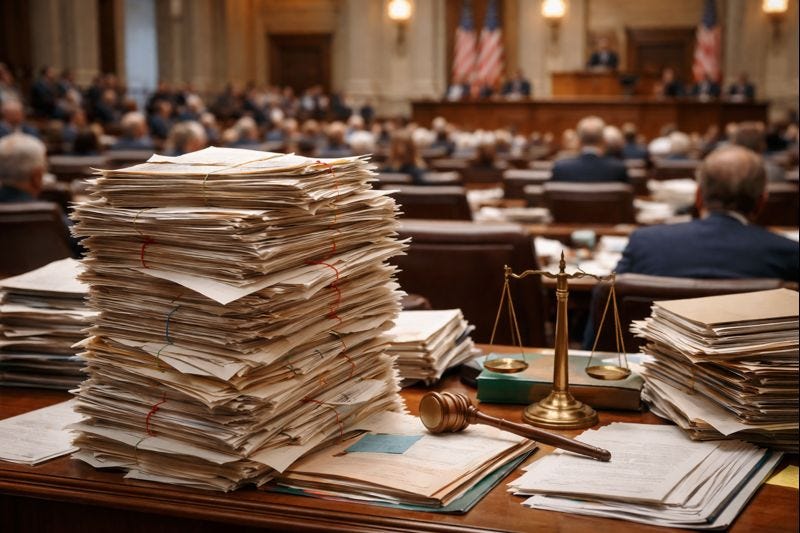
Modern governance has a reflex: if there’s a problem, write a rule. If there’s a loophole, add a form. If someone behaves badly, stack another layer of regulation on top and call it “progress”.
The real thing is that the societies that function best often need less of that.
There’s a strong idea in political economy: higher interpersonal trust is associated with lower demand for heavy regulation. In plain English: if you expect most people to behave reasonably, you don’t need to turn every behaviour into a legal article.
A widely cited paper by Aghion, Algan, Cahuc and Shleifer documents a robust relationship: more regulation is linked with less trust, and they describe a reinforcing loop. Distrust increases the public appetite for regulation, while regulation (especially when excessive or poorly designed) can discourage the formation of trust. Two possible equilibria emerge: a “good” one (more civic behaviour, lighter regulation) and a “bad” one (less civic behaviour, heavier regulation).
Now, here’s the contemporary US flavour of the same instinct: executive orders.
According to the Federal Register, President Donald Trump signed 225 executive orders in 2025 and 5 more in 2026 (so far), for a total of 230 across 2025–2026. The American Presidency Project reports the same order of magnitude, and Pew noted that by mid-December 2025 he had already surpassed the total number he signed in his first term.
Again: this isn’t automatically “good” or “bad”. Executive orders can be useful in genuine urgency. But the pattern is revealing. In low-trust environments, politics tends to drift towards “do it fast, do it from the top”, because legislating the slow way requires negotiation, patience, and a baseline belief that the other side is acting in good faith. When that belief collapses, governing starts to look like a permanent workaround.
Moral
Trust is invisible infrastructure.
When it exists, it lowers the cost of coordination: fewer controls, fewer formal constraints, less friction. When it doesn’t, you pay an unspoken tax: more rules, more enforcement, and a growing sense that nothing works unless it’s mandated.
Conclusion
That helmet debate left me with an uncomfortable thought: when a society needs to turn every sensible habit into a legal requirement, the issue is rarely the habit itself. It’s the level of trust underneath it.
Because legislation has a cost. Not just administrative or financial, but cultural. Every new rule sends a message, even if unintentionally: “we don’t expect you to do the right thing on your own.” Repeat that message often enough and people respond rationally, by outsourcing responsibility to the system. They comply to avoid trouble, not because they believe in the norm.
This isn’t an argument for a world without rules. It’s an argument for using rules for what they’re best at: protecting the essentials, preventing abuse, and providing clear guardrails where trust genuinely isn’t enough. But if we try to mandate every sensible behaviour, we end up with a brittle society: high friction, low initiative, and permanent dependence on enforcement.
On the slopes, most people wore helmets without being forced. The interesting question isn’t whether we can make helmets compulsory. It’s whether we can build the kind of institutions and culture where doing the sensible thing becomes the default, without needing a legal shove.
A helmet can’t save you from everything. Neither can a law
Sources
- Aghion, P.; Algan, Y.; Cahuc, P.; Shleifer, A. “Regulation and Distrust” (NBER / QJE 2010).
- Federal Register: Donald J. Trump executive orders (2025 and 2026 pages; totals by year and combined).
- The American Presidency Project: executive order statistics (Trump II totals through Jan 2026).
- Pew Research Center (Dec 2025): count of executive orders in the second Trump term vs first term.