
🚀 The Future Is Always Delayed
Technological predictions arrive late – and in unexpected forms

We grow up surrounded by promises about the future.
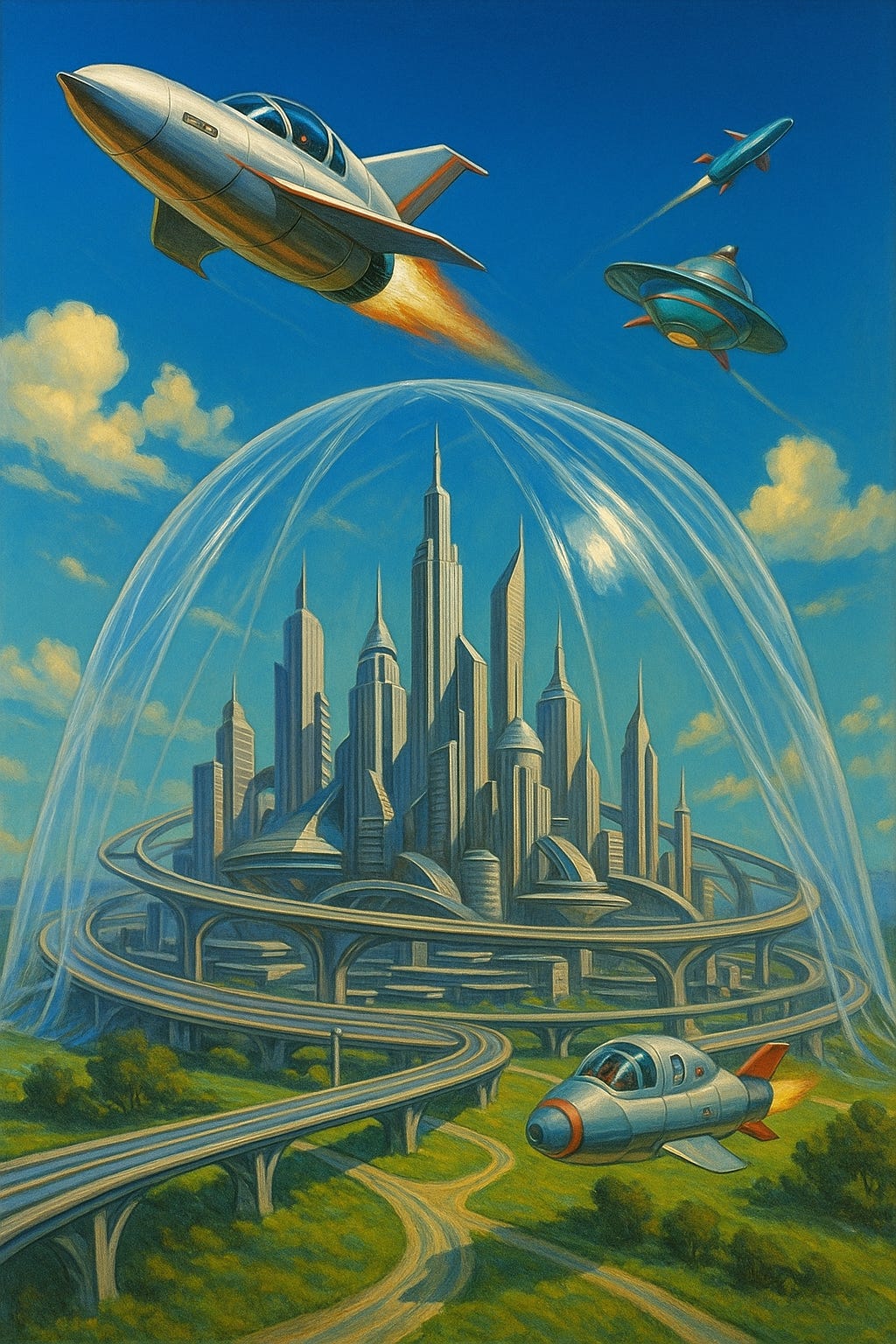
Flying cars. Robot assistants. Colonies on Mars.
Artificial intelligence that will “surpass humans” any moment now.
The list is long. The delays are longer.
If you look back at 150 years of technological predictions, a clear pattern emerges: the future always takes far longer than expected, and when it finally appears, it looks nothing like the original vision.
👉 If you like data that challenges your assumptions, you can subscribe here.
🧠 A brief history of technological optimism
In 1900, engineer John Elfreth Watkins published his predictions for the year 2000.
He foresaw cars travelling at 200 km/h on elevated highways, pneumatic trains, and instant “tele-photography”.
Some ideas were close.
Most arrived decades later, and in very different forms.
The same story repeats with:
Nuclear energy, once expected to be clean, limitless and cheap by the 1970s.
Lunar colonies, forecast by NASA in the late 1960s as achievable “around 1985”.
Self-driving cars, confidently promised “by 2020” for more than twenty years.
Artificial general intelligence, repeatedly predicted since 1956 to be “just around the corner”.
Every generation believes it stands at the edge of a breakthrough.
Every generation discovers that reality is more complex than the excitement of the announcement.
🔬 Why we’re always late
Because technology does not progress in straight lines.
It moves in jumps, setbacks, dead ends and unexpected turns.
Imagining the future is easy; building it is not.
Progress is slowed by:
Physical constraints that cannot be negotiated.
Costs that scale far beyond optimism.
Regulations that delay adoption.
Human limitations that no roadmap can magically solve.
🔍 Insight
We underestimate the complexity of change and overestimate the speed of progress.
🧩 Moral
The future always arrives… just later, and in a different shape.
📎 Sources
John Elfreth Watkins (1900). Predictions for the Year 2000 — Smithsonian Magazine.
NASA (1969–1975). Projections for lunar and Martian colonisation.
AI Winter Papers (1956–1990). Chronology of failed AGI predictions.
Rojas, R. (2006). The Elusive Quest for AI.
Historical analyses of technological hype cycles.