
When Everything Becomes a Number
The moment measuring everything started to ruin the experience

Some time ago I joined Goodreads to keep track of the books I read. The idea felt harmless enough: maintain a small record of what I’d read, remember the books I liked, maybe discover a few new ones.
But Goodreads has a small feature.
It asks you to set a yearly goal.
Twelve books. Twenty. Fifty. Whatever you choose.
At first it feels like a game. You set a target, finish a book, log it, and watch the little progress bar move forward. A small, slightly childish satisfaction.
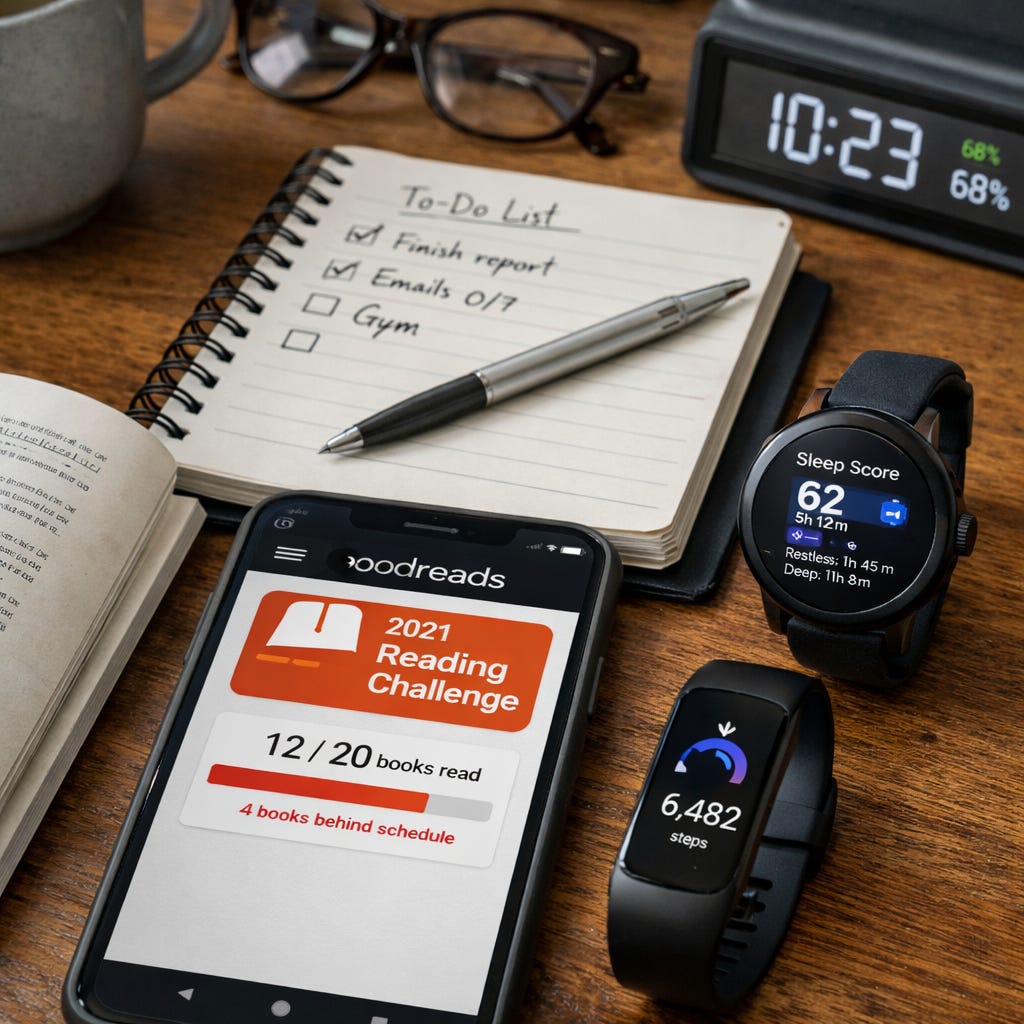
Until one day you open the app and notice you are three books behind schedule.
Something subtle changes. Reading is no longer just reading. Now it is also about catching up.
If you pick a long novel, you hesitate. Perhaps you should choose something shorter. If several weeks pass without finishing a book, the feeling becomes oddly uncomfortable, as if you were losing a race that nobody actually asked you to run.
The paradox is obvious: the anxiety did not exist before we started measuring it.
And Goodreads is hardly the only example.
Smartwatches tell you how well you slept. Productivity apps tell you how many tasks you completed. Fitness trackers tell you how many steps you walked.
Everything begins as a tool to improve habits.
But slowly the data stops being a guide and becomes a continuous evaluation of ourselves.
Moral
Measuring something changes our relationship with it.
Economists call this Goodhart’s Law: when a measure becomes a target, it stops being a good measure.
What used to be an experience becomes an indicator.
Sleep turns into a sleep score.
Reading turns into yearly progress.
Walking turns into step counts.
And when the number drops, anxiety appears.
Not because we are necessarily doing worse.
Simply because now we know.
Conclusion
Personal technology has turned everyday life into a small control dashboard.
In theory, that should help us live better.
In practice, it often just makes us more aware of our statistical imperfections.
Not everything in life improves when it is measured.
Some things work better when they simply happen.
Lectures
Goodhart, C. (1975). Problems of Monetary Management.
Etkin, J. (2016). The Hidden Cost of Personal Quantification, Journal of Consumer Research.
Lupton, D. (2016). The Quantified Self: A Sociology of Self-Tracking.
If you want practical, no-nonsense ways to apply AI at work, explore my guide: 5 Real Workflows to Use Copilot in Your Daily Work.